Jesper Armouti-Hansen

Publications & working papers

Research background

Four peer-reviewed papers in behavioral, organizational, and decision economics, plus working papers and replication code. The methods are econometric and the assumptions are stated; the replication packages are public.

Journal publications

Peer-reviewed work in behavioral, organizational, and decision economics.

2024 · Games and Economic Behavior

Efficiency Wages with Motivated Agents

Jesper Armouti-Hansen, Lea Cassar, Anna Dereky, and Florian Engl

145, pp. 66–83

Abstract

Many jobs serve a social purpose beyond profit maximization, contributing positively to society. This paper uses a modified principal-agent gift-exchange game with positive externality (prosocial treatment) to study how workers' prosocial motivation interacts with the use of efficiency wages in stimulating effort. We find that prosocial motivation and efficiency wages are independent in stimulating effort: compared to a standard gift-exchange game (GE treatment), the presence of the externality shifts the agents' effort choice function upwards without affecting its slope. Thus, if principals were profit-maximizers, wage offers should be the same in both treatments. However, principals offer higher wages in the prosocial treatment. We show that this is due to principals in the GE treatment highly underestimating agents' reciprocity and thereby offering wages below the profit-maximizing level. Results from robustness-checks further suggest that our findings are unlikely to be driven by a simple efficiency effect.


Games and Economic Behavior journal cover

2024 · Journal of Mathematical Economics

Managing Anticipation and Reference-Dependent Choice

Jesper Armouti-Hansen and Christopher Kops

112, 102988

Abstract

Extensive field and experimental evidence shows that reference points shape behavior. But, what shapes the reference point? Candidates put forward in the literature range from the status quo, to rational expectations and the narrow focus of dreaming or worrying about a single possible outcome. This paper develops a model that includes all of these candidate sources. It does so, by allowing the reference point to be any convex combination of the outcomes possible under a consumption lottery. We introduce new solution concepts for reference-dependent choices, characterize these solution concepts on the level of choice data and identify the model’s parameters.

Journal of Mathematical Economics journal cover

2020 · Journal of the European Economic Association

Optimal Contracting with Endogenous Project Mission

Jesper Armouti-Hansen and Lea Cassar

18(5), pp. 2647–2676

Abstract

Empirical evidence suggests that workers care about the mission of their job, in addition to their wage. This paper studies how organizations can choose a mission to attract, incentivize, and screen their workers. We analyze a model in which a principal offers a contract to an agent for the development of a project and can influence the agent’s marginal return of effort through the choice of project mission. The principal’s and the agents’ mission preferences are misaligned and the agents vary in the intensity of their mission drive. Our main results highlight that how far the organization chooses to move from its preferred mission depends on the contractual environment in which it operates. Missions will be more agent-preferred in environments in which effort is noncontractible. In environments in which agents’ drive is unknown, missions will be less agent-preferred and the organization will find it optimal to offer contract menus that may be implemented via scoring auctions when there are competing agents. Our analysis applies to the design and allocation of aid contracts, research funding, and creative jobs.

Journal of the European Economic Association journal cover

2018 · Theory and Decision

This or That? Sequential Rationalization of Indecisive Choice Behavior

Jesper Armouti-Hansen and Christopher Kops

84(4), pp. 507–524

Abstract

Decision-makers frequently struggle to base their choices on an exhaustive evaluation of all options at stake. This is particularly so when the choice problem at hand is complex, because the available alternatives are hard (if not impossible) to compare. Rather than striving to choose the most valuable alternative, in such situations decision-makers often settle for the choice of an alternative which is not inferior to any other available alternative instead. In this paper, we extend two established models of boundedly rational choice, the categorize then choose heuristic and the rational shortlist method, to incorporate this kind of “indecisive” choice behavior. We study some properties of these extensions and provide full behavioral characterizations.

Theory and Decision journal cover

Working papers & projects

Current work and replication material: stated assumptions, public code, and interpretation.

Working paper

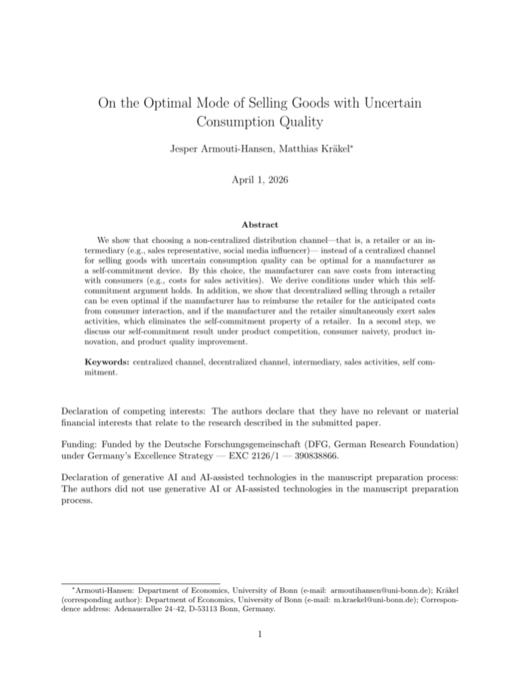
On the Optimal Mode of Selling Goods with Uncertain Consumption Quality

Jesper Armouti-Hansen and Matthias Kraekel

Abstract

We show that choosing a non-centralized distribution channel—that is, a retailer or an intermediary (e.g., sales representative, social media influencer)— instead of a centralized channel for selling goods with uncertain consumption quality can be optimal for a manufacturer as a self-commitment device. By this choice, the manufacturer can save costs from interacting with consumers (e.g., costs for sales activities). We derive conditions under which this self-commitment argument holds. In addition, we show that decentralized selling through a retailer can be even optimal if the manufacturer has to reimburse the retailer for the anticipated costs from consumer interaction, and if the manufacturer and the retailer simultaneously exert sales activities, which eliminates the self-commitment property of a retailer. In a second step, we discuss our self-commitment result under product competition, consumer naivety, product innovation, and product quality improvement.

Work in progress

Predictive Completeness of Social Preference Theories

Jesper Armouti-Hansen

A machine learning benchmark approach

Abstract

This project uses machine learning benchmarks to evaluate how much predictable variation in experimental social preference data is captured by parameterized behavioral models, including extensions with heterogeneous preference types.

2026 · Working paper

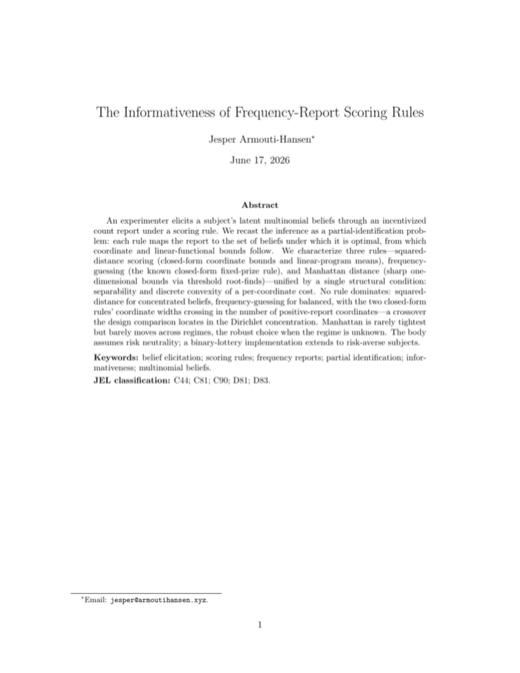
The Informativeness of Frequency-Report Scoring Rules

Jesper Armouti-Hansen

Manuscript complete; replication package finalised

Abstract

An experimenter elicits a subject's latent multinomial beliefs through an incentivized count report under a scoring rule. We recast the inference as a partial-identification problem: each rule maps the report to the set of beliefs under which it is optimal, from which coordinate and linear-functional bounds follow. We characterize three rules---squared-distance scoring (closed-form coordinate bounds and linear-program means), frequency-guessing (the known closed-form fixed-prize rule), and Manhattan distance (sharp one-dimensional bounds via threshold root-finds)---unified by a single structural condition: separability and discrete convexity of a per-coordinate cost. No rule dominates: squared-distance for concentrated beliefs, frequency-guessing for balanced, with the two closed-form rules' coordinate widths crossing in the number of positive-report coordinates---a crossover the design comparison locates in the Dirichlet concentration. Manhattan is rarely tightest but barely moves across regimes, the robust choice when the regime is unknown. The body assumes risk neutrality; a binary-lottery implementation extends to risk-averse subjects.